Protecting the Salish Sea
Salish Sea Vessel Traffic Projections
Friends of the San Juans monitors and analyzes vessel traffic associated with industrial development across the Salish Sea region to inform policy decisions and public understanding.
Friends released its first Salish Sea Vessel Traffic Projections analysis in 2015 to provide members, the public, and decision-makers with comprehensive information about projects throughout the Salish Sea that would increase the number of large commercial ocean-going vessel transits, highlighting the cumulative impacts of increased vessel traffic. Keeping a diligent eye on proposed projects, Friends has continued to track pertinent projects and published Salish Sea vessel traffic projections in 2019, 2021, and 2024 For the most up to date information on Salish Sea vessel traffic, see Friends’ 2026 Salish Sea Vessel Traffic Projections Report.
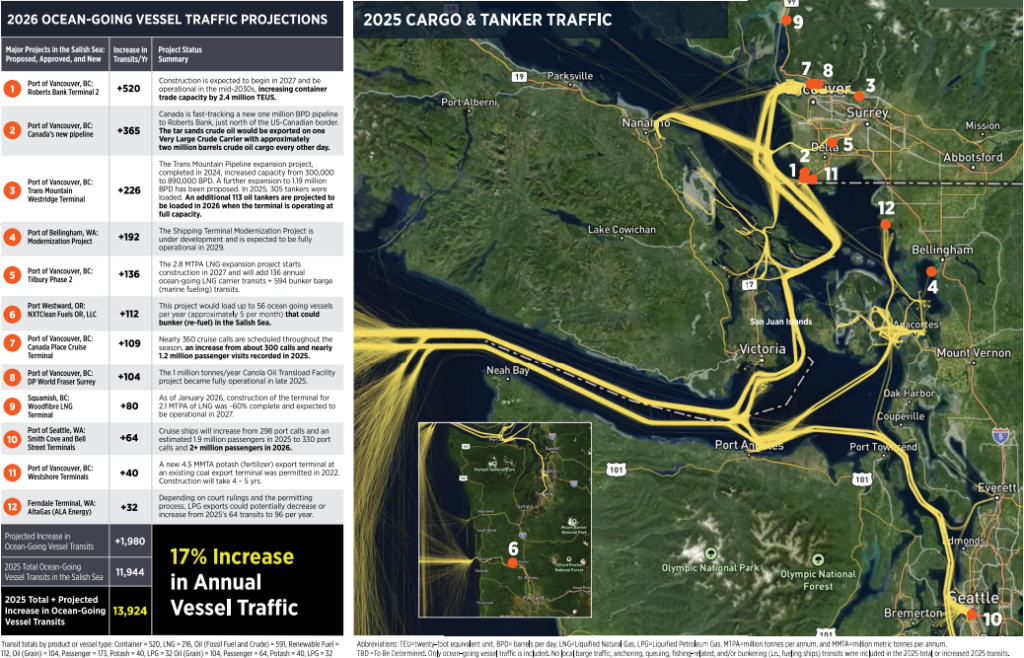
The 2026 report identifies 12 major new or expanding terminal and refinery projects in different stages of development. These projects (eight in British Columbia, four Washington State, and one in Oregon) could potentially add approximately 2,000 annual ocean-going vessel transits to and from Salish Sea ports.
The image below provides an overview of vessel traffic increases associated with Salish Sea ports and terminals. Each numbered location represents a port or terminal project that would increase vessel traffic. This enables a better understanding of where and why vessel traffic might increase and helps illustrate the potential cumulative impacts on local communities, maritime safety, and the marine ecosystem. We encourage you to print the handouts linked at the bottom of the page and to help raise awareness of the threat of increased vessel traffic in the Salish Sea.
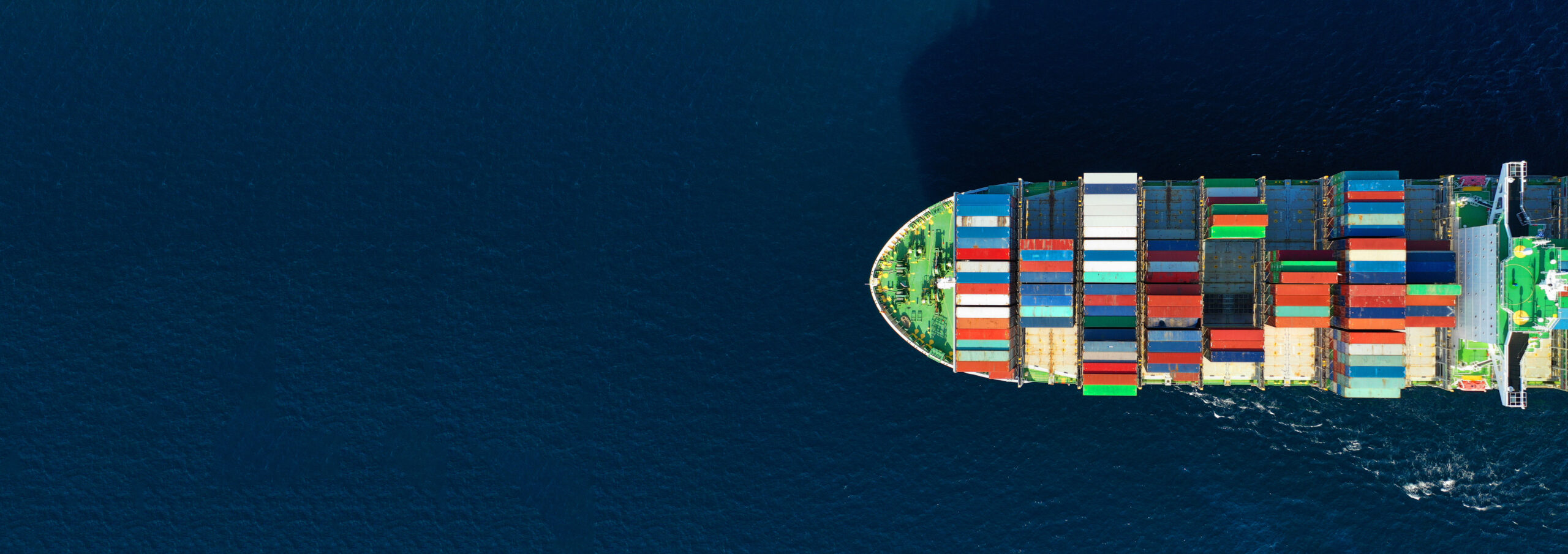
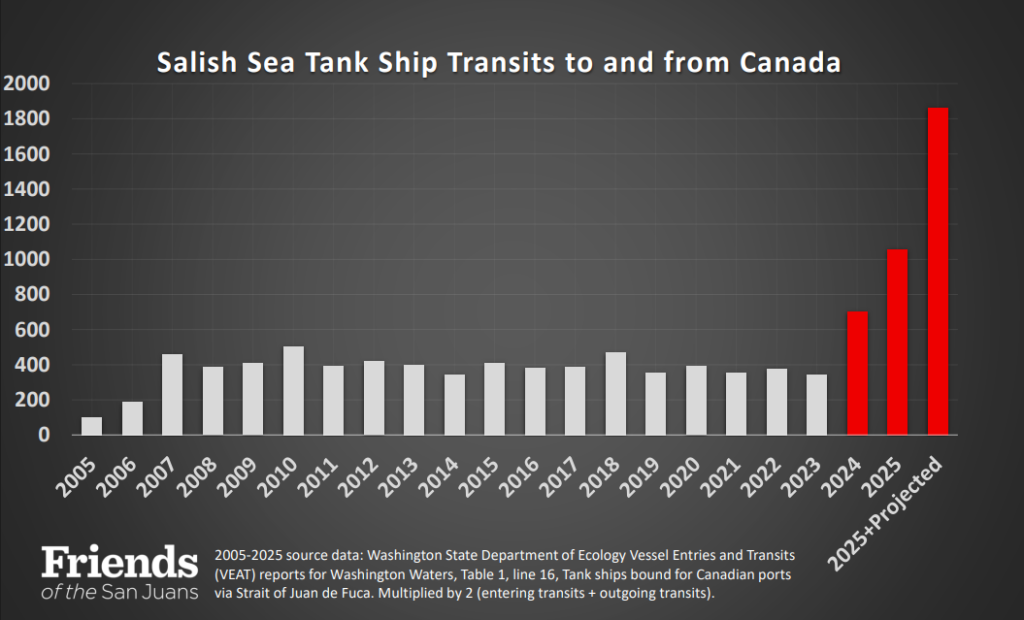
Most concerning is the recent and projected increase in tanker traffic to and from Canadian ports. The projected increase to 1,863 annual tanker transits is driven largely by Canada’s increase in fossil fuel exports. From 2007 to 2023, annual tanker traffic to and from Salish Sea ports in Canada remained relatively stable, averaging 400 voyages per year. According to the Department of Ecology’s Vessel Entries And Transits (VEAT) Reports for Washington Waters, tanker traffic surpassed 700 transits in 2024 and exceeded 1,000 transits in 2025. Projects, including the new one-million-barrel-per-day pipeline and export terminal just north of the U.S.-Canada border at Roberts Bank, could more than quadruple historical tanker traffic levels.
If all proposed, permitted, and recently constructed projects outlined in this report are realized there would be approximately 17 percent more large, ocean-going commercial transits than there were in 2025. In addition to the 12 projects that were used to calculate vessel traffic increases in 2026, Friends has identified 25 additional projects throughout the Salish Sea region — nine in British Columbia, fourteen in Washington State, and two in Oregon — that will likely result in increased vessel traffic and impacts in the Salish Sea. However, data on vessel traffic numbers associated with these projects are not publicly available, and therefore these 25 projects were not included in the 2026 projections.
Why It Matters
The Salish Sea region’s population is approximately 9 million and expected to grow to over 12 million by 2045. Eighty percent of globally traded goods are shipped by sea. As the region’s population grows, demand for global freight transportation is expected to increase, creating additional pressure for increased shipping in the Salish Sea.
The recent and proposed increases in vessel traffic in the Salish Sea highlight the need for a carrying capacity assessment. No regionwide threshold has been established for the volume and mix of vessel traffic that can safely navigate the Salish Sea. The exponential growth in tanker and Very Large Crude Carrier traffic alongside increases in container, cargo, and cruise ships, as well as recreational boats, has an unquantified increase in the risk of accidents and oil spills. No region-wide accident prevention and emergency response requirements have been identified that adequately address current and future risks.
Without proactive, coordinated policy intervention and agreement on ecosystem capacity thresholds, vessel traffic increases cannot be safely managed. As a result, shoreline communities, regional economies, Tribes’ and First Nations’ cultural and treaty-protected resources, maritime safety, and the marine ecosystem would face unacceptable impacts and risks.
Recommended Next Steps
- Initiate a multi-national (U.S., Canada, Tribes, First Nations) carrying capacity assessment.
- Align currently proposed and future project permitting with agreed upon ecosystem capacity thresholds.
- Conduct a transboundary cumulative vessel traffic risk assessment, revising accident and oil spill prevention and oil spill and other emergency response preparedness requirements as needed. If unable to conduct a region-wide assessment, the U.S., Washington State, Oregon, and Tribes should proceed with an assessment and revised requirements.
- Evaluate the effectiveness of voluntary mitigation measures and consider the expansion of voluntary and/or mandatory mitigation measures (e.g., vessel speed, routing, fuel use).
- Prohibit permits for projects throughout the Salish Sea that could increase vessel traffic until the above recommendations are completed.
Reports & Data
- 2026 Salish Sea Vessel Traffic Projections Report
- 2026 Salish Sea Vessel Traffic Projections Handout
- Department of Ecology’s Vessel Entries And Transits (VEAT) Reports for Washington Waters
- Previous Salish Sea Vessel Traffic Projections Reports and Infographics
- 2024 Report and Infographic
- 2021 Report and Infographic
- 2019 Infographic
- 2016 Infographic
- 2015 Infographic and source information
The 2015-2024 infographics were created in partnership with San Juan Islanders for Safe Shipping Co-founder, Shaun Hubbard. Friends of the Earth was also a partner in creating the 2016 Infographic.
Funding was provided for the 2026 Vessel Traffic Projections from Friends Members, The Northwest Fund for the Environment, The Harder Foundation, Stand Up To Oil, The Lummi Nation, and The Tulalip Tribes Charitable Fund.
Join Friends for Community-Centered Action
Whether you live in the San Juan Islands, visit often, or help care for the Salish Sea from afar, your actions make a difference. Together, we can protect what makes this place extraordinary—shorelines, wildlife, and community.