
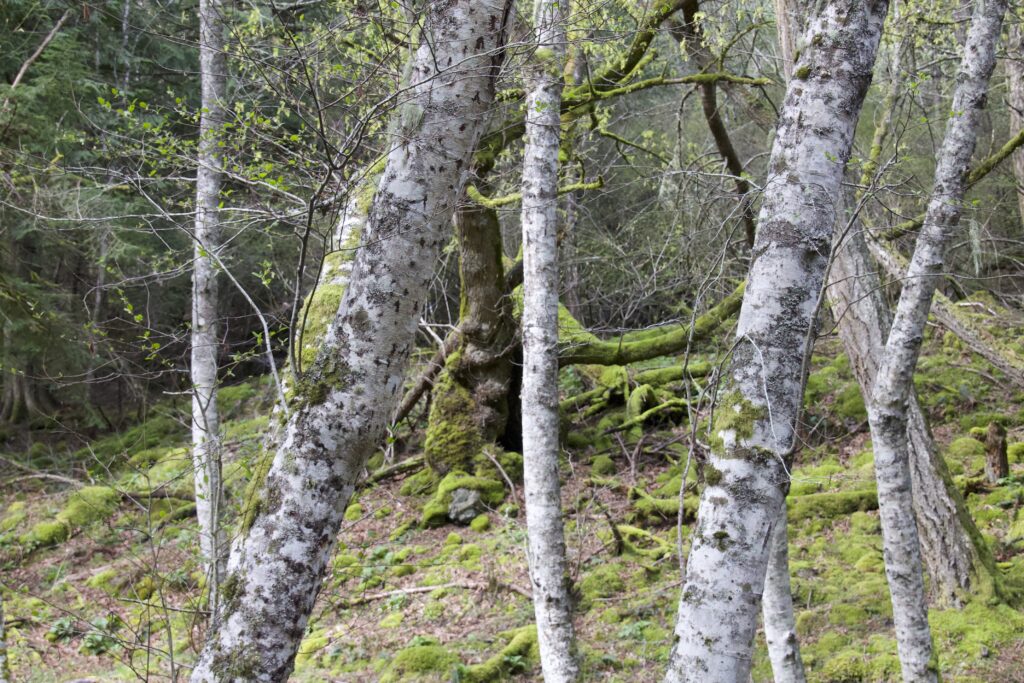
The Forest Resource Land (FRL) designation protects forests for forestry today – and for the future.
What are Forest Resource Lands?
Forest Resource Land (FRL) is a zoning label for parcels of land with soils and geography that make them suitable for commercial forestry use. Washington’s Growth Management Act instructs every county to designate enough FRL to support the long-term viability of forestry, meaning enough land for timber to support loggers, mills, and forest product producers.
Is it really necessary to designate Forest Resource Lands?
Yes! Not only does the Growth Management Act require San Juan County to designate FRLs but designating lands as FRL helps ensure that they will be used for forestry rather than conversion to denser industrial, commercial, or residential development. With development pressures higher than ever in San Juan County, we need FRLs so that the San Juans can support our current forest economy, to support our rural character, our native ecosystems and for benefits like reducing forest fire risks, protecting air and water quality, aiding aquifer recharge, providing access to recreational activities, improving wildlife habitat and connectivity, and sequestering carbon in the fight against climate change. Over time, however, the islands have seen a loss of FRLs through de-designations facilitated by the County.
How much Forest Resource Land do we need in San Juan County?
How much FRL is needed to support existing forestry activities? How much FRL will be needed in the future? The Comp Plan update process is supposed to include an assessment to answer these questions, but the County isn’t currently planning to do that. Local foresters tell us that we can’t afford to lose FRLs, yet that is what has happened in our county, historically. Since 2000, 167 acres of FRL have been de-designated here and in 2021, Friends commented against a recommendation by County Staff to de-designate another 127 acres of Forest Resource Lands to Rural Farm Forest. Thankfully, the proposal to de-designate those parcels was not adopted.
But aren’t Rural Farm Forest lands also zoned for forestry?
Yes, for small-scale forestry, but the “RFF” name can be deceptive:
RFF provides for rural residential development and allows many more kinds of uses than just farming and forestry. Most RFF parcels are 5 acres or smaller, and so support forestry only piece by piece. And as you can see from the list on the back, RFF lands allow for many more types of development than FRLs do, including uses that can conflict with forestry activities.
Forest lands hold so much more value outside of being an incredible resource for a commercial industry; a resource which can only be found on our planet. For instance, in this climate fight we need the ability to sequester as much carbon as possible, and mature forests do just that. The older the trees, the more carbon sequestration capacity they have. Forest lands also provide a space for humans and nature to connect. These are places where people can hike and explore as well as observe the intricacies and complexities taking place and forming outside of human society. However, the islands have over time seen incremental losses through de-designation, such as the county’s proposal to de-designate 127 acres of land a few years ago. Many times all that has stood between the continuous loss of forestlands has been Friends’ opposition, as documented by our track record.
What can I do?
Let the County Council know that you support local forestry jobs, our rural character, and the water quality, aquifer, habitat, and carbon-sequestering benefits that our island-scale forests provide. Request that the Council stop de-designating FRLs until they have identified the amount we need for a sustainable forest economy in the islands. Recommend that they also explicitly recognize secondary climate benefits of forests, including water quality, habitat, and carbon sequestration in San Juan County’s Comprehensive Plan update. With so many development pressures, tell the County Council that we need to designate more, not fewer FRLs in this Comp Plan update.
- San Juan County Council contact info can be found here.
- Comprehensive Plan update comments can be sent to: compplancomments@sanjuanco.com.
What’s the Difference Between RFF & FRL?
| Development | What Can Occur on RFF Land? | What Can Occur on FRL Land? |
|---|---|---|
| Maximum developable area for non-forestry use | 100% | 20% but not less than one acre |
| Maximum area of impervious surface | 30% not including driveways | 10% |
| Vacation Rentals | Yes | No |
| Bed and breakfast inns | Yes | No |
| Hangars | Yes | No |
| Multi-family residential units | Yes | No |
| Rural residential cluster development | Yes | No |
| Playing fields | Yes | No |
| Indoor swimming pools | Yes | No |
| Animal shelters and kennels | Yes | No |
| Veterinary clinics | Yes | No |
| Any commercial use with permit | Yes | No |