
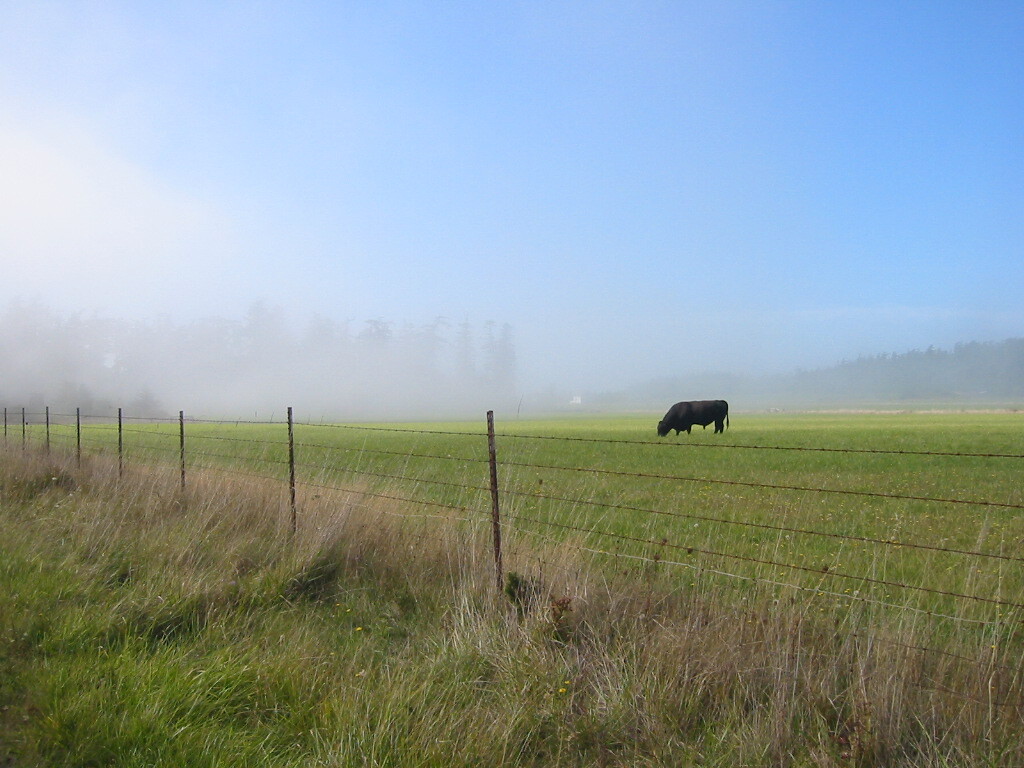
The Agricultural Resource Land (ARL) designation protects farmlands for farming today – and for the future.
What are Agricultural Resource Lands?
If you think of San Juan County’s Comp Plan as a roadmap for future development, zoning labels are like the specific directions on that map. They tell you exactly what kind of infrastructure you’re allowed to build and what activities are permitted in the different zones of the county. Agricultural Resource Land (ARL) is a land-use designation for large, often contiguous parcels of land with high quality soils and other factors that are designated for long- term farming and other agricultural uses. Washington State instructs counties to “review, and if needed, update their natural resource lands and critical areas designations” regularly, as part of the broader project of land use planning. ARL designation is determined by whether:
a) The land is not already characterized by urban growth,
b) The land is used or capable of being used for agricultural production,
c) The land has long-term commercial significance for agriculture.
Additionally, lands “that are currently used for agricultural production and lands that are capable of such use must be evaluated for designation. The intent of a landowner to use land for agriculture or to cease such use is not the controlling factor.”
Is it really necessary to designate Agricultural Resource Lands?
The San Juan Islands have a rich history of farming which continues to this day. From the original homestead apple orchards that still dot the islands, to alpacas, sheep, and organic vegetables, local agriculture plays an important role in our county economy. Without protective zoning, farmlands can be subdivided for residential and commercial development, damaging their productive capabilities. Washington State’s population is booming and development pressures are higher than ever in San Juan County. We need ARLs to support our current agricultural economy and for future food security. ARLs also support our rural character.
How much Agricultural Resource Land do we need in San Juan County?
There is not an easy answer to this question. However, with our population projected to reach 19,423 by 2036, and with the pressures of climate change growing, the importance of local food security will only increase in coming years. Those facts, combined with the need to find new ways to strengthen our local economy, diversify away from tourism, and lower cost of living for working families mean that we can be sure the answer is not “less.” Existing ARL must be protected, not decreased.
But aren’t Rural Farm Forest lands also zoned for farming?
Rural Farm Forest (RFF) is essentially the “default setting” for land use in San Juan County. It mainly provides for rural residential development and allows many more kinds of uses than just farming and forestry, although many small farms do exist on RFF. Most RFF parcels are 5 acres or smaller, which is not necessarily enough for all agricultural uses. RFF lands also allow for many more types of development than ARLs do, including uses that can conflict with agricultural activities. In short, while it is sometimes possible to conduct agricultural activities on RFF parcels, the RFF designation does not guarantee that those activities will remain possible on that parcel in the future.
What can I do?
You can let the County know where you stand on the protection of Agricultural Resource Lands by letting them know that you support a policy that increases the designation of both Agricultural Resource Lands and Forest Resource Land uses.. You can also let the County know that you support agrisolar use of agricultural resource lands with responsible decommissioning provisions, such as appropriate assurances for current and future agricultural use and the protection of soils.
Currently, there are approximately 13,900 acres of Ag Resource Land and 18,900 acres of Forest Resource Land in the County. The land in the County makes up a total of 111,300 acres. Most proposals, however, in recent years, the County has facilitated the chipping away at our Natural Resource Lands, infringing on the value these lands play in our fight against climate change and our ability as island communities to become independent of a tourist economy.
- San Juan County Council contact info can be found here.
- Comprehensive Plan update comments can be sent to: compplancomments@sanjuanco.com.
What’s the Difference Between ARL & RFF?
| Development | What Can Occur on RFF Land? | What Can Occur on ARL Land? |
|---|---|---|
| Maximum developable area for non-agricultural use | 100% | 20% but not less than one acre |
| Maximum area of impervious surface | 30% not including driveways | 10% |
| Vacation Rentals | Yes | No |
| Bed and breakfast inns | Yes | No |
| Hangers | Yes | No |
| Multi-family residential units | Yes | No |
| Rural residential cluster development | Yes | No |
| Playing fields | Yes | No |
| Indoor swimming pools | Yes | No |
| Animal shelters and kennels | Yes | No |
| Veterinary clinics | Yes | No |
| Any commercial use with permit | Yes | No |